In the UK, the terms "counselling" and "psychotherapy" are often used interchangeably, but they do have different meanings which generally indicate the type of therapy available, the number of sessions you might expect, and the level of training of the therapist. Although the distinctions can be blurred and may shift during sessions, some of the differences are explained below to help you understand what may seem a very confusing field.
-
Counselling generally refers to a form of talking therapy that focuses on specific issues or short-term problems, such as relationship difficulties, stress, or grief. It is usually short-term (typically 8 to 20 sessions) and tends to be more goal-oriented, although in the course of resolving a specific problem you may discover it is linked to broader or more complex issues. Both counsellors and therapists may offer this sort of therapy.
- Psychotherapy refers to forms of talking therapy that aim to help individuals notice, understand and work through thoughts, feelings, and behaviours that are causing distress to themselves or others. It is often a deeper, longer-term process which tries to address complex or long-standing issues such as negative patterns in relationships, chronic anxiety or depression, lack of confidence or sense of identity, eating disorders and the repercussions of trauma. Psychotherapy is appropriate for any enduring emotional problem: if you have struggled with distressing feelings for years six sessions of solution-focused counselling or CBT may help briefly but is not going to change anything in the long-term. Serious mental health conditions such as obsessional thoughts, personality disorders, psychotic episodes, dissociation, severe trauma and eating disorders need therapy with fully trained and experienced psychotherapists.
Some background...
In the UK prior to the millennium, the term "psychotherapy" used to refer to a range of psychodynamic and humanistic therapies practiced by psychotherapists with specific trainings lasting a minimum of 4 years which were accredited by the UK Council for Psychotherapy (UKCP). Counselling training was typically 2 years in duration, and was often seen as the first step in order to be accepted on a longer and more rigorous psychotherapy training. In September 2000 the British Association of Counselling added 'Psychotherapy' to its title and became BACP. Unfortunately in the UK, the terms "counselling" and "psychotherapy" are not regulated by law, which means that anyone can call themselves a counsellor or psychotherapist, and gradually the two terms have lost the clarity they originally possessed.
It's important to check the qualifications, experience, and registration of a therapist before starting therapy, but unless you do extensive research or understand the history of psychotherapy in the UK, few people seeking a therapist understand the impressive-sounding credentials quoted.
The SCoPEd framework
In an attempt to help the public distinguish different levels of training and experience the seven main membership organizations joined together to create the (even more confusing) SCoPEd framework which divides therapists and counsellors into three categories:
- Column A (Foundation): The entry point for newly qualified practitioners who work with common mental health presentations. (Counsellors with an initial 2 year or Level 4 counselling diploma)
-
Column B (Enhanced): For experienced practitioners who handle more complex client presentations and deeper therapeutic work. (UKCP Psychotherapeutic Counsellors who have 3 years training, plus experienced counsellors who have done additional training after their initial diploma)
- Column C (Advanced): For advanced practitioners and psychotherapists equipped to work autonomously with highly complex cases (All UKCP and BAC fully qualified practitioners with 4+ years training are column C, plus some senior accredited BACP etc members who have satisfied the criteria with additional CPD.)
References to ScoPEd are already appearing on sites such as Counselling Directory but at present it is creating further confusion. Few of the people mentioning it say which column they are in, others say they are 'working towards SCoPEd' and one said she had a 'SCoPEd Level 7' which is impossible! If you want to read through three columns each with about 125 competences you can find them and further information here: https://www.pcpb.org.uk/about-scoped-framework/
Membership does not always mean accreditation
It is natural to assume that if someone is a member of a reputable professional body their training and experience must meet certain standards. This is another area causing confusion for the public, as BPC and UKCP fit the model of only allowing fully qualified psychotherapists to be members, while BACP and NCS allow members to have widely different levels of qualification, so membership does not mean you are accredited or registered.
-
UKCP (UK Council for Psychotherapy): Membership = accreditation. A UKCP psychotherapist requires a minimum of 4 years professional training and a minimum of 450 hours of supervised practice before qualification. A psychotherapeutic counsellor has 3+ years training. Training must be with a small number of accredited training organizations which conform to equivalent standards. All UKCP registered members are fully trained and accredited.
-
BPC (British Psychoanalytic Council): Membership = accreditation. Psychoanalytic training is a long, demanding and expensive process which typically takes at least 6 years, often a lot longer. All BPC members are fully qualified.
-
BACP (British Association of Counsellors and Psychotherapists): Membership does not = accreditation. BACP membership (signified by the letters MBACP) is open to anyone with a basic counselling qualification who pays a membership fee and passes a short test. There have always been a large number of colleges offering counselling training but with very different approaches, at different levels and for different client groups. BAC united diverse counsellors with shared aims, but did not try to impose standards. BACP accreditation is a different, more demanding, process which only a small proportion of members apply for.
- NCS (National Counselling Society): Membership does not = accreditation. Another organization that has acted as an umbrella to bring together diverse counsellors and other practitioners. Historically it seems to have had less rigorous requirements for training and no links with accredited training organizations. In recent years NCS seems to be trying to tighten its requirements, and has now joined PCPB to use the SCoPEd framework for greater clarity.
Qualification levels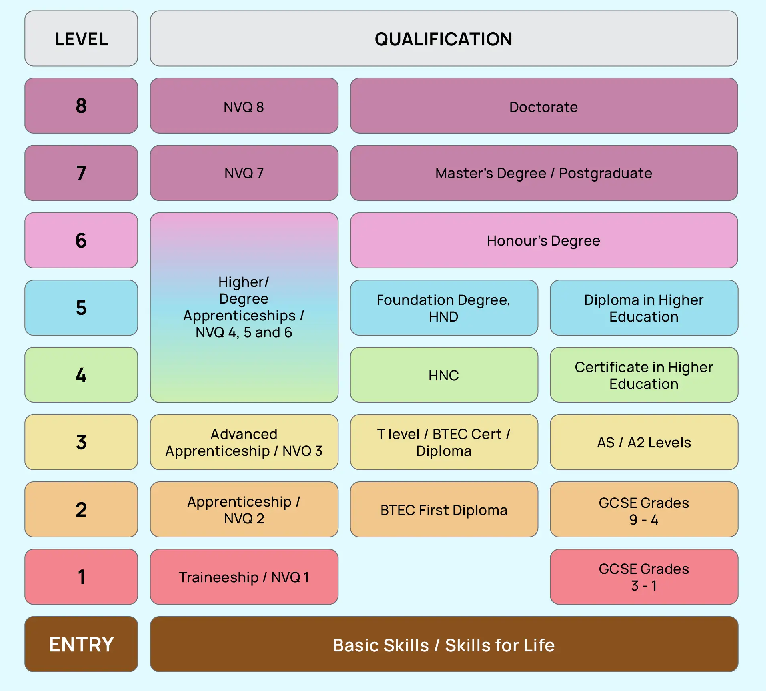
Without prior knowledge it can be hard to know the relative value of a diploma from one organization or another. There is a national system for comparing different qualifications - a simple version is illustrated to the right.
Essentially, many counselling diplomas are Level 4 qualifications roughly equivalent to the level of the first undergraduate year of a degree.
I understand the UKCP accredited psychotherapeutic counselling course run at Matrix in Norwich also gives an Honour's Degree to those who complete it, so is an example of a Level 6 training.
Full UKCP psychotherapy training is considered a Level 7 or Postgraduate qualification.
Some courses, such as Professional Doctorates in Counselling Psychology, give a Level 8 qualification which is partly academic and partly vocational training.